
After a breakdown, getting yourself somewhere safe matters more than getting the car moving. If it can’t continue, broken down car towing may be the practical next step, but first make sure you’re safe at the roadside.
A breakdown can leave you unsure whether to stay in the car, what to tell the recovery team or where the vehicle should go. Don’t try to push or tow it yourself if that could put you or the car at risk. Take things one step at a time.
This guide explains what to do first, which details to share with the recovery team and how to prepare your vehicle for transport. You’ll also learn how to arrange a tow in Essex to a home, garage or another agreed destination. HMD Recovery UK provides vehicle recovery and transport for broken-down cars, helping you plan a safe next step.
Key Takeaways
- Put your safety first after a breakdown. Make the vehicle visible and assess the situation before arranging help.
- For broken down car towing, share clear details about the vehicle, its location and access conditions.
- Let the vehicle’s condition and where it has stopped guide the choice between a repair and recovery transport.
- Before collection, agree where the car is going and gather essential belongings only if it’s safe to approach.
- HMD Recovery UK can transport a broken-down or non-running car in Essex to a home, garage or other agreed destination.
Broken Down Car Recovery: How to Stay Safe
A breakdown can leave you unsure what to do first. Keep it simple: stop as safely as you can, make the car visible to other road users, then assess the danger. Your safety comes before checking the fault or arranging broken down car towing. Don’t attempt a repair or move the vehicle if doing so would put you near traffic or in another unsafe position.
What should you do when your car stops moving?
If the car is still controllable, aim for a safe place away from moving traffic, such as a nearby lay-by or suitable parking area. Don’t force it to travel further if it feels unsafe to drive. If it stops in a dangerous position or obstructs traffic, use your hazard lights to warn other road users.
Leave the vehicle or move to a safer place only when it’s safe to do so. Avoid roadside repairs beside live traffic. A quick inspection isn’t worth the risk. If the car can’t safely continue, arrange recovery rather than trying to push or tow it yourself. For a general overview of recovery methods, see Vehicle recovery.
What changes if you break down on a motorway in Essex?
A live motorway needs extra care. Don’t cross traffic lanes or try to reach a safer place on foot across the carriageway. If you can, move towards an emergency area or another safe stopping place. Follow the current Highway Code and National Highways guidance for your exact location, including on the M25 where it runs through Essex.
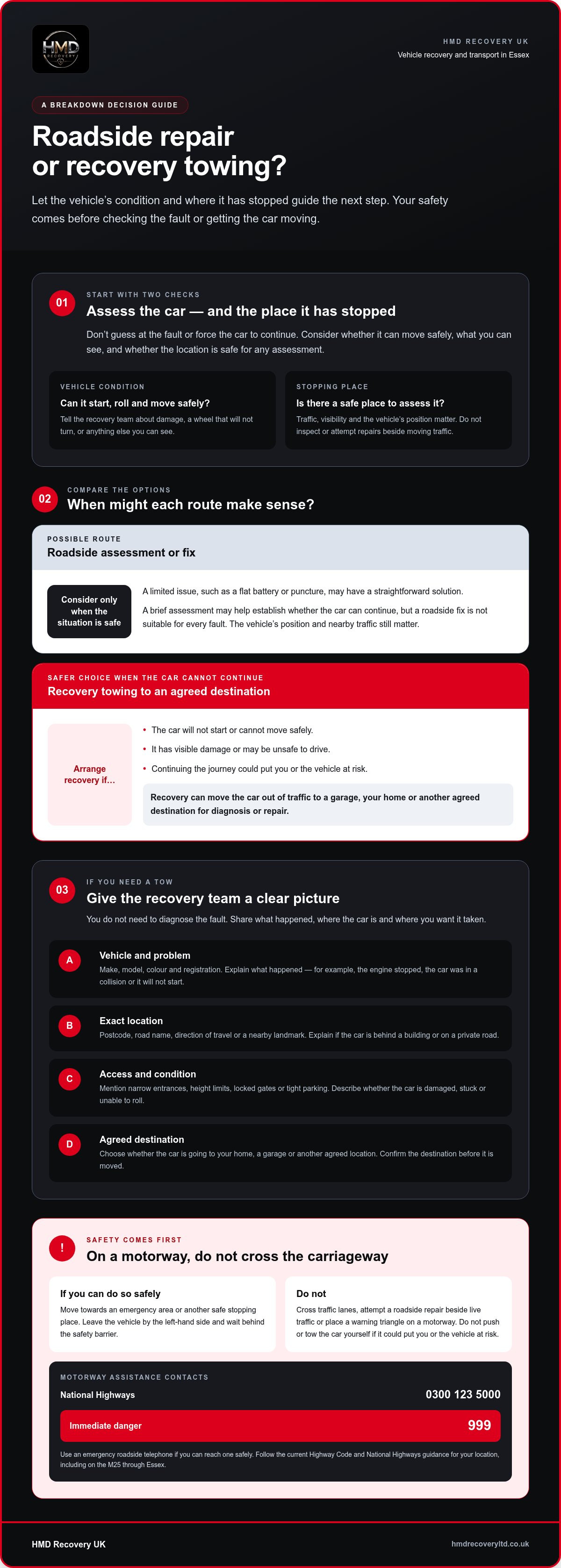
National Highways advises leaving the vehicle by the left-hand side where it’s safe, then waiting behind the safety barrier. Don’t place a warning triangle on a motorway. Use an emergency roadside telephone if you can reach one safely, or call National Highways on 0300 123 5000. Call 999 if there’s immediate danger.
Conditions differ between a motorway, a busy A-road and a quiet street. Consider traffic, visibility and where you can wait safely. Once you’re out of immediate danger, give the recovery team your location and explain what has happened. These details help plan the collection without asking you to take unnecessary risks.
How Broken Down Car Towing Works, From Your Call to Collection
Vehicle recovery moves a car that can’t safely continue its journey. For broken down car towing, the key details are what has happened, where the car is and where you want it taken. Clear information helps the recovery team plan the collection and account for access conditions or vehicle problems.
The main stages are to explain the breakdown, give the location, plan the collection and agree the destination. If you’re unsure what to do while waiting, check the official Highway Code rules for breakdowns for safety guidance.
What information should you give when arranging a tow?
Describe the car and the problem as clearly as you can. Share its make, model, colour and registration, then explain what happened. For example, say whether the engine stopped, the car was involved in a collision or it won’t start. You don’t need to diagnose the fault.
- Location: Give a postcode, road name, direction of travel or nearby landmark. Add a clear description if the vehicle is behind a building or on a private road.
- Access: Mention narrow entrances, height limits, locked gates or a tight parking space.
- Vehicle condition: Explain whether the car is damaged, stuck or unable to roll. These details can affect how the team plans to load it.
- Destination: Say whether you want it taken to your home, a garage or another agreed location.
Be honest about what you can see. A wheel that won’t turn or a car facing an awkward direction is useful information, even if you don’t know why it has happened.
What happens when the recovery vehicle arrives?
The driver considers the car and the collection position. A vehicle on a quiet street presents different access conditions from one in a narrow car park or close to moving traffic. The team can then choose a suitable recovery method and secure the car for transport. Don’t try to reposition it unless it’s safe and the driver asks you to do so.
Before the vehicle is moved, agree the destination and make sure the details are clear. Recovery can take a broken-down or non-running car to a home, garage or other agreed place. HMD Recovery UK provides vehicle recovery and transport in Essex. If your car can’t continue safely, broken-down vehicle recovery can move it to your chosen destination. Share the location, condition and destination when arranging the collection.
Towing or Roadside Repair: How to Decide What Your Broken Down Car Needs
A roadside fix can get a car moving again, but it isn’t always the safe or sensible choice. Base the decision on the car’s condition and where it has stopped, not a guess about the fault. If you’re unsure whether the vehicle is safe to drive, broken down car towing lets it be moved for further checks instead of continuing the journey.
| Roadside assessment or fix | Towing to a garage or destination |
|---|---|
| A possible option when the issue appears limited, such as a flat battery or puncture, and the car is in a safe place for assessment. | A safer choice if the car won’t start, cannot move safely, has visible damage or may be unsafe to drive. |
| May help establish whether the car can continue, but a roadside fix isn’t suitable for every fault. | Moves the vehicle out of traffic and to a garage, home or another agreed destination for diagnosis or repair. |
When might a roadside fix be enough?
A flat battery or puncture can sometimes have a straightforward solution. But the fault alone doesn’t determine whether it’s safe to deal with at the roadside. The vehicle’s position, nearby traffic and what can be safely assessed all matter. A brief assessment may help establish the next step, but don’t inspect or attempt repairs beside moving traffic. If the car is in a hazardous spot, focus on safety and arrange recovery instead.
When is towing the safer option?
Choose transport if the car won’t start, can’t move safely or has visible damage. The same applies if you notice warning signs or can’t tell whether it’s roadworthy. Don’t keep driving to see if the problem clears. Even a short distance can expose you and other road users to risk or make damage worse.
A tow doesn’t mean the fault is necessarily serious. It’s a practical way to get the vehicle somewhere it can be checked properly. HMD Recovery UK transports broken-down and non-running vehicles for further diagnosis or repair. Tell the recovery team what you’ve noticed, where the car is and whether it can roll. Those details help plan the collection without relying on a roadside guess.
How to Prepare a Broken Down Car for Towing in Essex
A few clear details can make a recovery collection easier to plan. Before the vehicle is collected, share where it is, how the driver can reach it and where you want it taken. Don’t put yourself at risk to gather information or prepare the car. If it’s stopped somewhere dangerous, stay in a safe place and follow current official guidance for that type of road.
What should you do before the tow arrives?
Use this checklist when arranging broken down car towing in Essex. Share what you know, but approach the car only if it’s safe.
- Give a precise location. Provide the postcode, road name, direction of travel or a nearby landmark. Describe exactly where the car is positioned, such as in a marked bay, behind a building or on a driveway.
- Explain access. Mention gates, narrow entrances, parking restrictions, low clearance or other obstacles. If traffic or parked vehicles limit access, say so.
- Confirm the destination. Tell the recovery team whether the car is going to your home, a garage or another agreed location.
- Keep useful details ready. Have the registration and vehicle details to hand, along with the keys if you can reach them safely.
- Take essentials only if safe. Collect items you need from the car only when you can approach it without entering a live traffic area or other danger.
Don’t restart, move or work on the vehicle just to make collection easier. If it won’t start, is damaged or is stopped in an unsafe position, leave it alone and explain the situation. The recovery team can use those details to plan a suitable approach.
How can you make collection easier on local roads?
Essex collection points can range from a residential street to a busy road or restricted parking area. A nearby landmark and a plain description of the car’s position can help the driver find it. Mention narrow access, parked cars or traffic that could affect where the recovery vehicle can stop. Don’t wait beside live traffic to guide it in.
If the car is on a motorway, don’t approach it or wait in an exposed place to assist with collection. Follow the current Highway Code and National Highways advice for your exact situation. Conditions and safe options can differ by location, so use official guidance rather than guessing.
HMD Recovery UK provides broken-down car recovery in Essex. Share the vehicle’s location, access details and destination when arranging transport.
Arrange Broken Down Car Towing in Essex with HMD Recovery UK
If your car can’t continue safely, the next steps are straightforward: get yourself to a safe place, explain the vehicle’s condition and arrange suitable transport. You don’t need to identify the fault. Tell the recovery team what you’ve noticed, where the vehicle is and whether it can move or roll. This helps plan the collection without adding guesswork to an already stressful situation.
HMD Recovery UK provides vehicle recovery and transport for broken-down and non-running cars in Essex. The vehicle can be taken to your home, a garage or another agreed destination. Choose the destination that suits your next step, whether that’s keeping the car at home or taking it somewhere for further diagnosis.
What can HMD Recovery UK help with after a breakdown?
Recovery is a practical option when a car can’t safely continue its journey. HMD Recovery UK can transport the vehicle to an agreed destination, and its repair services can address mechanical, electrical or structural problems. You don’t need to decide on a repair at the roadside. The first priority is moving the car safely; repair needs can be dealt with separately.
What is the next step when your car needs towing?
Share the details that help make the arrangement clear:
- Your location: Give a postcode, road name or nearby landmark, plus where the car is positioned.
- Vehicle details: Provide its registration and describe what happened. Mention if it’s damaged or unable to roll.
- Your destination: Choose a home, garage or other agreed location for the vehicle to be taken.
Clear information helps the recovery team understand the job and plan around access conditions. If the car is in a risky position, don’t approach it to gather details. Your safety comes first. Pass on what you can from a safe place, and leave the vehicle where it is until recovery is arranged.
There’s no need to make a roadside diagnosis or try to get the car moving. If it can’t be driven safely, broken down car towing can move it to a suitable place for inspection or repair. Keep the conversation focused on the location, condition and destination. Those details help set out a practical recovery plan.
Information about broken-down car recovery is available from HMD Recovery UK.
Take the Next Step with a Clear Recovery Plan
A breakdown can feel overwhelming, but the next steps are manageable. Put your safety first, then explain where the car is and what has happened. Share any access difficulties and agree where the vehicle should go. These details make broken down car towing easier to arrange and help the recovery team plan a suitable collection.
If the car can’t continue safely, HMD Recovery UK provides recovery and transport for broken-down and non-running vehicles in Essex. The car can be taken to your home, a garage or another agreed destination. Repair services are also available for mechanical, electrical and structural issues, so you can consider the next step once the vehicle has been moved.
Give the location, vehicle details and destination, then arrange the transport you need. Arrange broken-down car recovery in Essex with HMD Recovery UK.
Frequently Asked Questions
What should I do first when my car breaks down?
First, get yourself and the vehicle to a safe place if you can do so without creating more danger. Switch on your hazard lights if the car is stopped where it may obstruct or surprise other road users. Don’t try to inspect or repair it beside moving traffic. If you’re on a motorway, follow current Highway Code and National Highways advice for that location before arranging recovery.
Can I tow a broken-down car with a rope in the UK?
Sometimes, but towing with a rope isn’t automatically safe or suitable. The car must be controllable, and both vehicles and drivers need to be capable of handling the manoeuvre. A rope tow can be risky in traffic, on busy roads or if the broken-down car has steering or braking problems. Don’t attempt it if you’re unsure. Arrange vehicle recovery and transport instead, particularly if the car can’t be moved safely.
How do I know whether my broken-down car needs towing?
If the car won’t start, can’t move safely, has visible damage or shows warning signs you don’t understand, don’t continue driving. The vehicle’s condition and its position on the road matter more than trying to guess the fault. If you can’t tell whether it’s safe to drive, arrange a tow to a garage or another suitable destination. HMD Recovery UK transports broken-down and non-running vehicles in Essex.
What information do I need to arrange broken down car towing?
Share the vehicle’s registration, make and model, then describe what happened and what you can see. Give the clearest location you can, such as a postcode, road name, direction of travel or nearby landmark. Explain access issues, including narrow entrances or restricted parking. Say whether the car is damaged or unable to roll, and where you want it taken. These details help plan broken down car towing in Essex.
Can a broken-down car be towed to my home or a garage?
Yes. Recovery transport can take a broken-down car to your home, a garage or another agreed destination. Tell the recovery team where you want it delivered when arranging the collection. Include access details, such as a narrow driveway or a parking restriction, so the destination can be considered as part of the plan. HMD Recovery UK provides vehicle recovery and transport for broken-down and non-running cars in Essex.
Is it safe to wait in my car after a breakdown?
It depends on where the car has stopped and whether you can reach a safer place without risk. On a motorway, National Highways guidance advises leaving by the left-hand side if it’s safe and waiting behind the safety barrier. Don’t cross traffic lanes. On other roads, avoid stepping into live traffic. If you’re in immediate danger, call 999; otherwise follow the relevant official roadside guidance.
Can a car be repaired instead of towed after a breakdown?
Sometimes. A roadside assessment may show that a repair is suitable, but not every fault can be fixed safely where the car has stopped. Don’t try a repair in a dangerous position or drive on if you’re unsure the vehicle is roadworthy. HMD Recovery UK provides vehicle repairs for mechanical, electrical and structural issues, as well as transport to move a car to a suitable place for diagnosis or repair.

