
Your vehicle stops on a busy road. Traffic keeps moving, and you’re left wondering where to wait and who to call. Roadside vehicle recovery starts with staying safe, then sharing clear details so suitable help can be arranged.
It’s normal to be unsure what to do next. Is roadside assistance the same as recovery? Does the vehicle need a repair, a tow or transport to another location? This guide explains what to do after a breakdown, what details to give the recovery team and how to choose the vehicle’s next destination.
You’ll also learn how recovery differs from roadside assistance and vehicle transport. For drivers in Essex, HMD Recovery UK provides recovery and transport for broken-down, accident-damaged and non-running vehicles. Your vehicle can be taken to a home, garage or another agreed location. Knowing what information to share can help make arrangements clearer, whether you’re on a local road or travelling elsewhere in the UK.
Key Takeaways
- Roadside vehicle recovery moves a vehicle that can’t safely or reliably continue, to a destination agreed as part of the plan.
- Share your location, vehicle details and a plain description of the problem to help arrange suitable support.
- Roadside assistance, recovery and vehicle transport describe different types of help. Knowing the difference makes it easier to explain what you need.
- Put safety first while you wait, follow current official roadside guidance and update the recovery team if your location or the vehicle’s condition changes.
- HMD Recovery UK provides recovery and transport for broken-down, damaged and non-running vehicles, including transport to a home, garage or another agreed location.
What roadside vehicle recovery means when your car cannot continue
A breakdown can leave you unsure whether to wait, move the vehicle or arrange help. The key question is whether it can continue safely. Understanding what recovery involves helps you decide what to explain when arranging support.
Roadside vehicle recovery is the collection and movement of a vehicle that cannot safely or reliably continue its journey. The vehicle can be taken to a home, garage or another agreed destination. Recovery gets it from where it has stopped to a suitable place for its next step.
Vehicle recovery covers different ways of moving vehicles. For a driver dealing with a breakdown, the practical distinction is straightforward: roadside assistance may address a problem where the vehicle has stopped, while recovery transports the vehicle if it can’t continue or shouldn’t be driven.
When does a vehicle need recovery rather than roadside help?
A car that won’t start may need to be moved rather than driven. The same can apply after an accident if damage makes it unsafe or unreliable to continue. Whether the vehicle can proceed depends on its condition, not simply on whether the engine starts.
Roadside help and recovery aren’t always separate stages. Assistance may resolve the issue without transport. If it doesn’t, the vehicle may need to go to a garage, your home or another agreed place. Don’t try to diagnose a fault by guesswork. Describe what happened and what you can see so the next step can be arranged sensibly.
What types of vehicle and breakdown can recovery involve?
Recovery can involve cars, vans and other non-running vehicles. A vehicle may have stopped because it won’t start, or it may be unable to move after an accident. These situations can call for different arrangements, so explain what has happened and whether the vehicle can move.
An accident-damaged vehicle may need transport even if it still starts or can roll. That doesn’t mean it’s safe to drive. HMD Recovery UK provides recovery and transport for broken-down, accident-damaged and non-running vehicles, with destinations such as a home, garage or another agreed location.
How roadside vehicle recovery works, from first call to drop-off
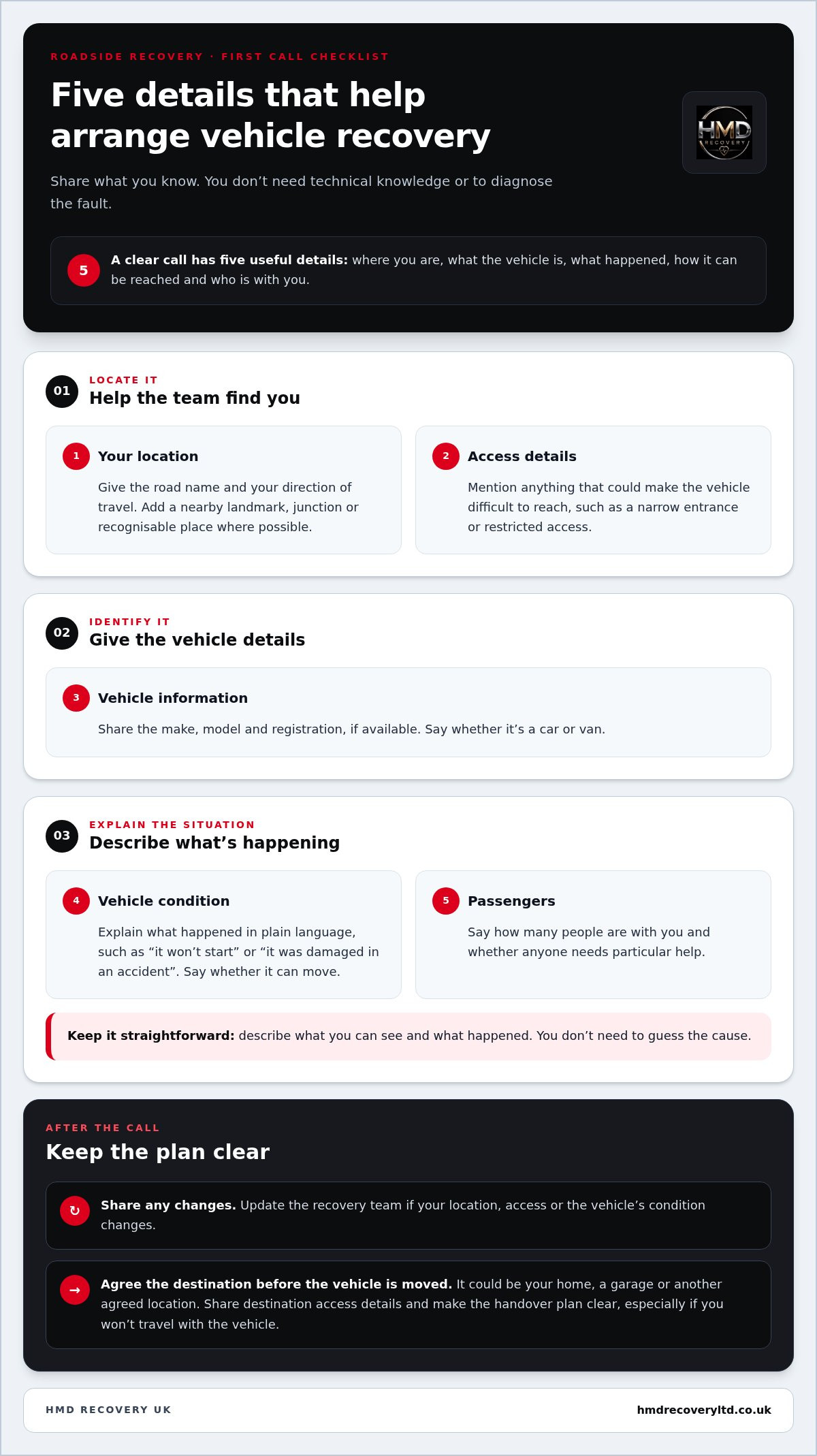
A clear first call helps the recovery team understand what has happened and where the vehicle is. You don’t need technical knowledge: share the details you have, describe the vehicle’s condition and agree where it should go.
What information should you give when arranging recovery?
Give practical details that help identify the vehicle and locate it safely. In Essex, a road name alone may not be enough, especially on an unfamiliar route. Add your direction of travel and a nearby landmark, junction or recognisable place where possible.
- Location: road name, direction of travel, nearby landmark and clear access instructions.
- Vehicle: make, model and registration, if available. Say whether it’s a car or van.
- Condition: explain what happened in plain language, such as “it won’t start” or “it was damaged in an accident”. You don’t need to diagnose the cause.
- Access: mention anything that could make the vehicle difficult to reach, such as a narrow entrance or restricted access.
- Passengers: say how many people are with you and whether anyone needs particular help.
Update the recovery team if your location, access or the vehicle’s condition changes. Accurate information helps the team find the vehicle and understand the situation.
What happens when the recovery vehicle arrives?
The operator needs to locate the vehicle and understand its condition. Point out visible damage or explain what happened, if you can do so safely. If you don’t know what caused the problem, a straightforward description is still useful.
Before the vehicle is moved, agree its destination. This could be your home, a garage or another location you choose. Make the handover plan clear, particularly if you won’t be travelling with the vehicle. Share any access details for the destination to help avoid confusion at drop-off.
The process depends on the vehicle and the situation, but the essentials are the same: give a precise location, describe the condition and agree the destination. HMD Recovery UK provides recovery and transport for broken-down, damaged and non-running vehicles in Essex and across the UK. Read more about vehicle recovery and transport.
Roadside assistance, vehicle recovery or transport: which help fits?
These terms overlap, but describe different outcomes. Roadside assistance aims to deal with a problem where the vehicle has stopped. Recovery moves a vehicle that can’t continue safely. Transport means taking it to a chosen destination, such as a home or garage.
A breakdown doesn’t always mean a roadside fix is possible. The vehicle’s condition and the circumstances matter. Assistance may get a car moving again, or the vehicle may need to be transported instead.
| Type of help | Purpose and likely outcome | When it may be relevant |
|---|---|---|
| Roadside assistance | Tries to address a fault at the roadside. The vehicle may be able to continue if the issue is resolved. | When the problem might be dealt with where the vehicle has stopped. |
| Vehicle recovery | Moves a vehicle that can’t continue or shouldn’t be driven. | When the vehicle is non-running, damaged or unsafe to drive. |
| Onward vehicle transport | Takes the vehicle from its current or recovery location to an agreed destination. | When it needs to reach a home, garage or another chosen location. |
When might roadside assistance be enough?
Roadside assistance focuses on trying to resolve a problem without transporting the vehicle. The outcome depends on the fault and the vehicle’s condition. A roadside attempt may not get the vehicle going, or the issue may still make driving unsafe. If so, recovery can be the practical next step. Policy details vary; Experian offers a general explanation of roadside assistance coverage, though its information may not reflect UK policy terms.
When is recovery or onward transport the clearer option?
Choose recovery when the vehicle can’t continue or shouldn’t be driven. Transport then takes it to a suitable place for what happens next, such as your home, a garage or another agreed location. Consider where the vehicle can be safely received and where any inspection or repair could take place.
The decision isn’t about choosing the right label. It’s about the vehicle’s condition and the outcome it needs. HMD Recovery UK provides recovery and transport for broken-down, damaged and non-running vehicles, alongside vehicle repairs. Explain what has happened and where you’d like the vehicle taken to arrange support for the situation.
What to do while waiting for roadside recovery
Safety comes first. Follow current official roadside guidance for the road and conditions you’re in. Don’t take risks to inspect the vehicle, retrieve something or make yourself easier to see. If you’re unsure what to do, use the latest advice in the Highway Code and National Highways’ breakdown guidance.
How can you stay safe after a breakdown?
There isn’t one action that suits every breakdown. Traffic, the road layout, weather and the vehicle’s position all affect what’s safe. Follow the current Highway Code and National Highways guidance, and avoid moving around the vehicle or roadside if doing so could put you at risk.
Keep your phone available so you can receive calls or pass on updates. If your position changes, access becomes difficult or the vehicle’s condition worsens, tell the recovery team. Clear, current details help the team locate the vehicle and understand the situation.
What should you prepare for the vehicle handover?
Get the keys and relevant vehicle details ready only if you can do so safely. Don’t return to the vehicle or approach it just to collect them if its position or the surrounding traffic makes that unsafe. Explain what you have and where the keys are when the recovery team arrives.
Keep the agreed destination in mind. If a home, garage or other location has a narrow entrance, access restriction or another practical issue, share that information before the vehicle is moved. This helps make the handover clearer and avoids confusion at the destination.
For a breakdown in Essex, make your location easy to describe. Give the road name, direction of travel and a nearby landmark or junction. If you’re unsure of your exact position, use details you can safely see or share from your phone. Update the recovery team if you move or find a clearer reference point.
Once the plan is clear, stay somewhere safe and keep your phone close. For recovery and transport in Essex or across the UK, arrange vehicle recovery with HMD Recovery UK.
Arrange roadside vehicle recovery with HMD Recovery UK
A breakdown leaves you with decisions to make, but the next step can be straightforward: explain what happened, share the vehicle’s location and agree where it should go. HMD Recovery UK provides recovery and transport for broken-down, accident-damaged and non-running vehicles in Essex and across the UK.
Clear details help shape a practical plan. Describe the vehicle’s condition in plain language, give the road location and direction, and mention anything that could affect access. Then choose a suitable destination: a garage for attention, your home while you consider what to do next, or another agreed location.
Where can recovery take your vehicle?
Recovery can take your vehicle to a home, garage or another agreed destination. Think about where it needs to go next, not only where it can be moved from the roadside. If a garage is expecting the vehicle or the destination has limited access, share those details when arranging help.
For drivers in Essex, precise location information is particularly useful on unfamiliar roads. HMD Recovery UK also provides recovery and transport for customers across the UK. Share the destination and any access details so the drop-off can be planned around the vehicle’s next stop.
What is the next step after recovery?
The next step depends on the vehicle’s condition and your plans. You may want it taken home before deciding what to do. Or you may choose a garage so the vehicle can be assessed for repair. HMD Recovery UK also provides repairs for mechanical, electrical and structural issues. Recovery takes the vehicle to the agreed location; repair is a separate step in its onward journey.
Keep the arrangement simple: explain the situation, share the location and confirm the destination. You don’t need to know the technical cause of a fault to describe what happened. Clear information links the roadside problem with a suitable next step.
If your vehicle can’t continue, arrange roadside vehicle recovery with HMD Recovery UK. Share the details and agree where you’d like the vehicle taken.
Take the next step with confidence
A breakdown is easier to manage when you focus on three things: stay safe, explain what happened and give a clear location. Roadside vehicle recovery moves a vehicle that can’t safely continue, while roadside assistance may help without transport. The right option depends on the vehicle’s condition and what needs to happen next.
Share the vehicle details you have, describe the fault or damage plainly and agree where it should go. HMD Recovery UK provides recovery and transport for broken-down, accident-damaged and non-running vehicles. Your vehicle can be taken to a home, garage or another agreed location. Repairs may also be a next step, depending on the vehicle and your plans.
If your vehicle needs moving, arrange roadside vehicle recovery with HMD Recovery UK. A clear plan helps you decide what comes next.
Frequently Asked Questions
What is roadside vehicle recovery?
Roadside vehicle recovery moves a vehicle that can’t safely or reliably continue its journey. It may be taken from the roadside to your home, a garage or another agreed location. The destination depends on what you need next and the vehicle’s condition. HMD Recovery UK provides recovery and transport for broken-down, accident-damaged and non-running vehicles in Essex and across the UK.
What should I do first if my car breaks down on the road?
Put safety first and follow current official guidance for the road and conditions around you. The Highway Code and National Highways provide UK roadside safety advice. Avoid actions that could put you at risk, such as approaching the vehicle if it isn’t safe to do so. When you can, note your location and share it with the recovery team, along with any change in the vehicle’s condition.
Can roadside vehicle recovery take my car to a garage?
Yes. Recovery can take your car to a garage, your home or another agreed destination. Tell the recovery team where you want it taken and share useful access details, such as a restricted entrance or a suitable place to leave the vehicle. If you’re considering repairs, a garage may be the next stop. HMD Recovery UK also provides vehicle repairs for mechanical, electrical and structural issues.
How do I arrange vehicle recovery in Essex?
To arrange vehicle recovery in Essex, contact HMD Recovery UK and explain what has happened. Give the road name, direction of travel and a nearby landmark or junction to help identify your location. Describe the vehicle’s condition and agree where it should be taken. HMD Recovery UK provides recovery and transport in Essex and across the UK.
What information should I give when calling for vehicle recovery?
Share your location, vehicle details and a plain description of the problem. Give the make, model and registration if available. Include the road name, direction of travel and a nearby landmark, especially on an unfamiliar Essex road. Mention access restrictions, passenger numbers and your preferred destination. You don’t need to diagnose the fault; explain what you’ve noticed.
Can a damaged or non-running car be recovered?
Yes. HMD Recovery UK provides recovery and transport for accident-damaged and non-running vehicles, as well as vehicles that have broken down. Describe visible damage and whether the vehicle can move. Don’t assume it’s safe to drive just because it starts or can roll. Share the details when arranging help so the vehicle’s condition and destination are clear.
What is the difference between roadside assistance and vehicle recovery?
Roadside assistance aims to deal with a problem where the vehicle has stopped, without transporting it. Recovery moves the vehicle when it can’t continue safely or reliably. Assistance may resolve an issue, but that doesn’t mean the vehicle can be driven afterwards. Its condition determines the practical next step. If it needs moving, recovery can take it to a home, garage or another agreed destination.

