

Is your car safe to drive, or could another journey make the problem worse? When a fault leaves you stranded or unsure, choosing between car repairs and recovery can feel like one more thing to manage.
It helps to separate the two. Recovery moves a vehicle that can’t safely or reliably continue. Repairs address the fault that’s stopping it from being used. Sometimes you need one service; sometimes recovery is the first step before repairs can begin. You don’t need to diagnose the problem yourself, but clear details about the car, its symptoms and its location help the team understand what’s needed.
This guide explains how to judge whether to drive or arrange recovery, when repairs may be needed, and how the two services can work together. You’ll also learn what information to share when requesting help, such as the vehicle’s make and model, its location and any warning lights. HMD Recovery UK provides vehicle recovery and transport across Essex, alongside repairs for mechanical, electrical and structural issues.
Key Takeaways
- A car that still moves may not be safe to drive. Learn when to stop and arrange recovery instead.
- Use the vehicle’s condition and location to decide whether you need repairs, transport or both.
- Make arranging car repairs and recovery in Essex simpler by preparing clear details about the vehicle and fault.
- Understand how recovery can get a damaged or non-running vehicle to the next stage of its repair.
- Find out when scrap collection may be the practical route for a vehicle that’s unwanted or at the end of its life.
Car repairs and recovery: what each service can solve
A vehicle fault can leave you with two separate questions: what needs fixing, and how will the car get to the right place? Car repairs and recovery can be different stages of the same problem. Repairs focus on the fault or damage. Recovery moves the vehicle when it can’t continue safely or under its own power.
Recovery moves a vehicle to a suitable location; repair work diagnoses and fixes its faults or damage. You may need repairs alone if the vehicle is already somewhere it can be assessed. You may need recovery alone to transport it. If it breaks down away from home and needs work, both services may be part of the solution.
What does vehicle recovery cover?
Recovery and transport move a broken-down, damaged or non-running vehicle from its current location to a home, garage or another designated place. This can help when the car won’t start, has stopped working on the road or has been damaged and shouldn’t be driven further. Choose a destination that suits the next step, such as taking the vehicle somewhere safe or to a garage for repair.
Roadside assistance can help you arrange the next step when a vehicle stops unexpectedly. If you’re unsure what happens during collection or what to do while waiting, the guide Roadside Recovery: What to Expect and What to Do explains the process in more detail.
What kinds of problems can car repairs address?
Repair work can address mechanical, electrical and structural issues. Some signs are obvious, such as visible damage. Others are less clear, such as a warning light or a change in how the vehicle behaves. These symptoms offer useful clues, but they don’t always reveal the cause. An assessment helps identify the fault before repair work is decided.
A warning light doesn’t tell you by itself whether the car is safe to drive, and visible damage doesn’t always show the full extent of a problem. Assessment helps establish what needs attention. HMD Recovery UK carries out repairs for mechanical, electrical and structural issues, with the work guided by the fault found.
Think of the services as two parts of a practical route, not competing choices. First consider the vehicle’s condition and location. Can it be driven safely to where it needs to go? If not, recovery can move it. Once it’s in a suitable place, repair work can address the underlying issue. If it’s already at a garage or at home, transport may not be needed.
For Essex drivers, HMD Recovery UK provides local and long-distance vehicle recovery and transport, alongside repair work. Knowing whether the vehicle moves, what symptoms you’ve noticed and where it is helps clarify which step makes sense. You don’t need to name the fault. Describe what’s happening so the next stage can be planned around the vehicle’s condition.
When does a car need recovery before repair?
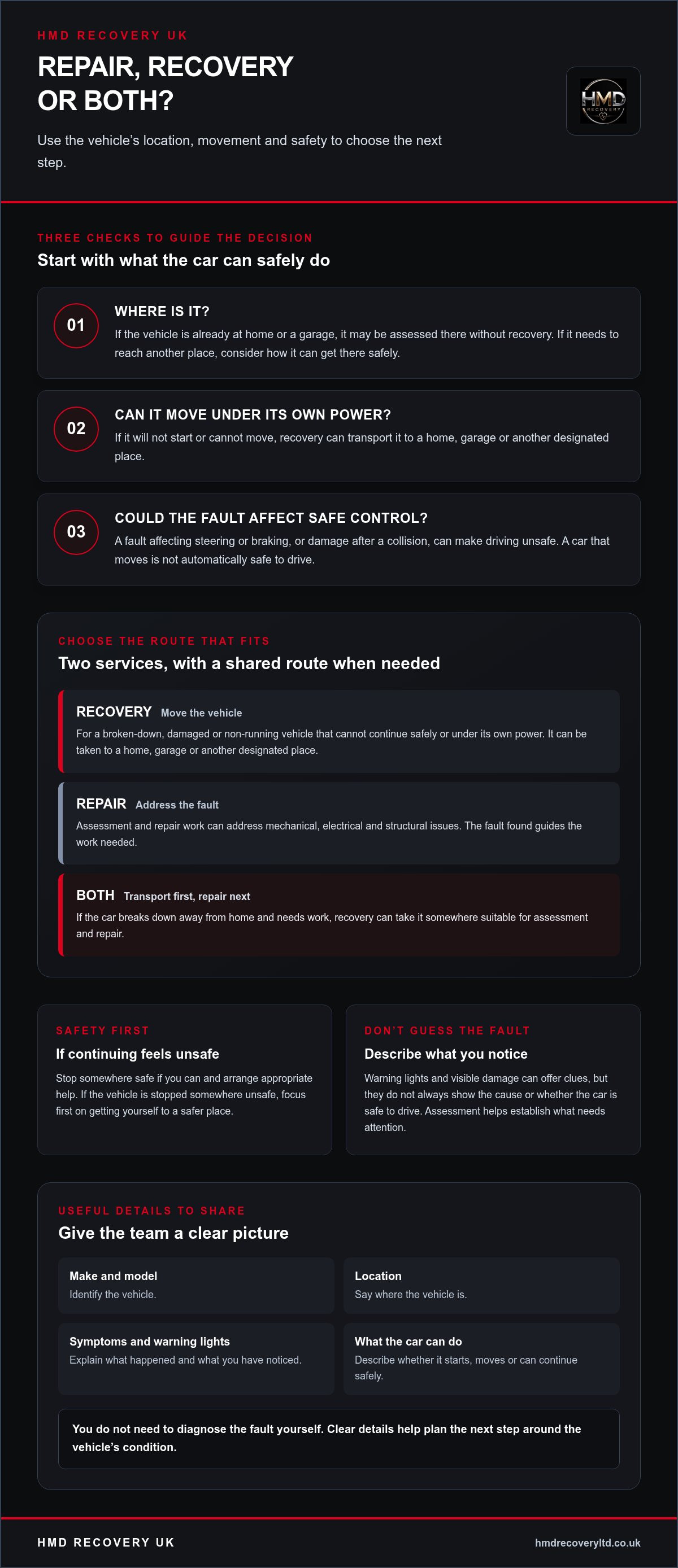
A car that can still move isn’t automatically safe to drive. It may start and roll, yet have a fault that affects control or could make the problem worse on the way to a garage. The key question isn’t simply, “Can it move?” It’s whether it can be driven safely in its current condition.
If continuing feels unsafe, stop somewhere safe if you can and arrange appropriate help. Don’t risk a longer journey just to reach a repair location. Recovery can take the vehicle there instead, without relying on it to make the trip under its own power.
Signs that recovery may be the safer next step
Arrange transport if the vehicle won’t start or can’t move under its own power. Recovery may also be sensible after a collision, or if a fault affects safe control, such as steering or braking. Don’t judge safety by appearance alone. Damage can be less visible than the problem it causes, and a car that moves may still be unsuitable to drive.
Describe what happened and what the vehicle can or can’t do. Avoid trying to diagnose a safety-critical fault yourself. If the car is stopped somewhere that feels unsafe, focus first on getting yourself to a safer place, then seek help with the vehicle.
When repair can be the main priority
A vehicle already parked at home or at a garage may need repair without roadside recovery. The fault and the vehicle’s condition shape the next step. A car in a suitable location can be assessed there, while one that can’t be driven safely may need transport first. Don’t assume a roadside repair will be suitable. The fault needs to be understood before the repair approach is decided.
Use these questions to make the decision clearer:
- Where is the vehicle? If it’s already somewhere suitable for assessment, recovery may not be needed.
- Can it move under its own power? If not, it needs transport to reach its next destination.
- Could the fault affect safe control? If yes, don’t rely on the car being able to move as proof that it’s safe to drive.
Recovery isn’t only for a vehicle with severe, visible damage. A breakdown with no obvious damage can still leave a car unable to continue, and a less dramatic fault can still affect whether it’s safe to drive. The practical choice depends on the vehicle’s behaviour, its location and whether it can reach a repair place safely.
For drivers in Essex, HMD Recovery UK provides vehicle recovery and transport, followed by repair work where needed. If the car is already at home or a garage, you can also arrange vehicle repairs without treating recovery as an automatic first step. Match the help to the situation: move the vehicle when it can’t safely get there, and focus on repair when it’s already in the right place.
Repair, recovery or both? Compare the right route for your situation
Choose the next step by looking at three things: where the vehicle is, whether it moves and what you want to happen next. A car that can’t reach a suitable repair location may need transport first. One already at a garage may need assessment and repair only. An unwanted vehicle has a different route altogether.
| Situation | Likely service need | Practical next step |
|---|---|---|
| The vehicle has broken down and won’t move | Recovery, followed by repairs if needed | Arrange transport to a home, garage or other designated location where its condition can be assessed. |
| The vehicle is already at a garage | Diagnosis and repair | Describe the symptoms and discuss the fault so repair work can be considered. |
| The vehicle is unwanted or at the end of its life | Scrap car collection | Arrange collection if you no longer want to keep the vehicle. |
Choose recovery, repairs or both by vehicle condition
If a vehicle is stranded and can’t run, transport may be needed before it can be assessed or repaired. If it’s already at a repair location, recovery may add an unnecessary step: focus on diagnosis and the work needed. For a vehicle that’s unwanted or at the end of its life, collection may suit the owner’s aim better than repair. Damage alone doesn’t mean a car should be scrapped.
Compare the practical route, not just the service label
Start with the location. Is the car at the roadside, at home or already at a garage? Then consider whether it moves and whether you want it repaired, transported or collected because you no longer need it. These details shape the useful next step. A destination could be your home, a garage or another place you’ve designated for the vehicle.
Some situations call for more than one service. For example, recovery can get a non-running vehicle to a repair location, then repair work can address the fault. These are distinct jobs: one moves the vehicle, while the other deals with its condition. Scrap collection is separate too. It’s for vehicles the owner wants to dispose of, not a default choice for every damaged car.
For Essex drivers, HMD Recovery UK provides vehicle recovery and transport, alongside repairs and scrap car collection. Recovery can cover local or long-distance transport, with the destination guided by what you need next. If you’ve worked out which route fits, arrange vehicle recovery, transport or repairs with the team. Share where the vehicle is, whether it moves and the outcome you’re looking for. That gives a clear starting point for planning the right service.
How to prepare for car repairs and recovery in Essex
A clear description helps the team understand whether you need repair work, transport or both. You don’t need to know the mechanical cause. Share what you’ve noticed, where the vehicle is and what it can do. These details make arranging car repairs and recovery in Essex more straightforward.
Details to have ready when you contact the team
Pinpoint the vehicle’s location. Give the road or address, town, postcode and a nearby landmark if useful. Mention access details too, such as a narrow entrance, parking restrictions or a vehicle parked in a difficult-to-reach spot. This helps the team understand where the vehicle is and what the collection or repair arrangement involves.
Then describe the vehicle and what happened. Share its make and model, the symptoms you noticed and whether it starts or moves. If you know what you need, say whether you’re arranging repairs, transport to a destination or collection of an unwanted vehicle. If you’re unsure, explain the situation instead.
Share the vehicle’s location, make and model, what happened, its symptoms, whether it starts or moves, and your preferred destination or outcome.
What to do while you wait for the next step
Put your safety first. If you’re dealing with a roadside breakdown, follow relevant roadside safety guidance and instructions from emergency services or roadside signs. Don’t try to move the vehicle if that could put you or others at risk. Keep the keys and any vehicle documents you have to hand where it’s practical and safe to do so.
Use this short sequence to get the essential details in order:
- Pin down the location. Note the address, postcode or road, plus any access information that could help someone reach the vehicle.
- Describe the vehicle. Give its make and model, then explain what happened and what symptoms you’ve seen or heard.
- Explain its condition. Say whether it starts, moves or is completely non-running. Don’t test it if doing so could create more risk.
- Set out the next step. Share the destination for transport, if known, or say whether you’re seeking repair or collection.
Accuracy matters more than technical language. “It stopped and won’t start” is useful. So is “there’s visible damage and I don’t know if it’s safe to drive”. If the vehicle is at a home or garage, give the access details and explain where it’s parked. If it’s at the roadside, describe its position as clearly as you can from a safe place.
HMD Recovery UK provides vehicle recovery and transport across Essex, along with repairs for mechanical, electrical and structural issues. Have the details above ready, then contact the team to arrange vehicle help.
Car repairs and recovery in Essex with HMD Recovery UK
HMD Recovery UK helps Essex drivers arrange vehicle recovery, transport and repairs. These services address different needs. Recovery moves a vehicle that can’t continue. Repair work deals with mechanical, electrical or structural issues. You may need transport before a repair can be assessed, or repair work alone if the vehicle is already at a suitable location.
The right route depends on the vehicle’s condition and your aim. Is it broken down and in need of a garage? Is it damaged but needs to be moved somewhere else? Or is it unwanted, with collection rather than repair as the intended outcome? Explaining this at the outset helps the team understand what you’re looking to arrange.
Recovery, transport and repair support
HMD Recovery UK provides local and long-distance transport for broken-down, damaged or non-running vehicles. The vehicle can be taken to a home, garage or another designated location. Recovery addresses the move; it doesn’t itself diagnose or repair the fault.
Repair work covers mechanical, electrical and structural issues. Once the vehicle is in a suitable place, its condition can be assessed and repair work considered. The aim is to address the fault and help restore the vehicle to a safe, roadworthy condition. The repair needed depends on what the assessment finds.
Keeping these steps distinct makes the process easier to plan. If a vehicle can’t safely reach a repair location, arrange transport first. If it’s already at home or a garage, focus on the repair. If you need both, recovery can move the vehicle so repair work can follow. Share the vehicle’s location, whether it moves and what symptoms you’ve noticed when arranging help.
Scrap car collection when repair is not the intended outcome
Repair isn’t the right goal for every owner. If a car is unwanted, scrap or MOT-failed, collection may be the relevant service. This is a separate option for a vehicle you intend to dispose of, not a default choice for a car that’s simply damaged or broken down. The decision rests on what you want to do with the vehicle.
For example, a non-running car you want to keep may need recovery to a garage, followed by an assessment. A vehicle you no longer want may instead be suitable for collection. Making that distinction helps avoid arranging repair or transport when disposal is the actual aim.
HMD Recovery UK provides vehicle recovery and transport across Essex, vehicle repairs and collection of unwanted, scrap or MOT-failed vehicles. Contact the team with the vehicle’s location, make and model, its condition and the service you need. Arrange recovery, transport, repairs or scrap collection by sharing those details and explaining what you want to happen next.
Take the next step with confidence
You don’t need to have every answer before you act. If you’re unsure what the vehicle needs, start with what you’ve noticed and what you want to happen next. A clear first conversation can help turn an uncertain situation into a practical plan.
Focus on the immediate priority. Is the vehicle preventing you from getting on with your day? Are you weighing up whether to keep it? Or do you need to understand what repair work may be involved? Explain what you know and be open about what you don’t. There’s no need to guess at a fault or decide every detail in advance.
With car repairs and recovery, the useful next move is the one that fits your vehicle and circumstances. Contact HMD Recovery UK to arrange the vehicle service you need in Essex and take the next step with a clearer plan.
Frequently Asked Questions
Can recovery and repairs be arranged for the same car?
Yes. Recovery can move a car to a suitable location, then repair work can address the fault. For example, if your car stops on a journey and can’t reach a garage, arrange transport before discussing repairs. Tell the team you may need both stages. You don’t need to know the cause of the breakdown to explain the situation.
How much do car repairs and recovery cost?
The cost depends on the work involved and the vehicle’s circumstances, so there isn’t one figure that applies to every job. Recovery costs can depend on details such as the vehicle’s location and destination. Repair costs depend on the fault and the work required after assessment. Contact HMD Recovery UK with those details to discuss your situation and the relevant service.
Is it safe to drive a car with a mechanical fault to a garage?
Not necessarily. A mechanical fault can affect how the car behaves, and being able to start or move it doesn’t establish whether it’s safe to drive. If you notice a change in control, hear an unusual noise or see a warning light, don’t rely on appearance alone. Stop somewhere safe if possible and seek suitable help before setting off for a garage.
Can a non-running or MOT-failed car be collected?
Yes. HMD Recovery UK provides recovery and transport for non-running vehicles, and collection for scrap and MOT-failed vehicles. The right arrangement depends on what you want to happen to the car. If you intend to keep it, transport or repairs may be relevant. If it’s unwanted or at the end of its life, scrap collection may be a better fit.
How long does vehicle recovery take in Essex?
Recovery time can vary with the vehicle’s location, destination and the details of the job. Share the exact area in Essex, whether the car is accessible and where you need it taken. These details help the team understand the journey involved. HMD Recovery UK provides local and long-distance transport, and the time will depend on your particular arrangement.
What information should I provide when arranging car recovery?
Give the team your location, the vehicle’s make and model, what happened and whether it starts or moves. Add a nearby landmark or access detail if the location is hard to find. Explain where you want the car taken, such as a home or garage. If you’re arranging car repairs and recovery, mention both so the next steps can be discussed together.
What happens if my car breaks down but I do not know what is wrong?
You can still arrange help without naming the fault. Describe what happened just before the car stopped, any dashboard warning lights, unusual sounds or changes in how it drove. Say whether it will start now, but don’t keep trying if that could create a safety risk. These observations give the team a useful starting point for arranging recovery or discussing repair assessment.


