
What should you do before arranging an end of life car collection, especially if the car won’t start or is difficult to reach? A few practical checks can make the collection and handover easier.
It’s understandable to be unsure about the V5C, personal belongings or how a non-running car can be collected. Have the vehicle details and access information ready so the collection team can understand the job before collection.
This 2026 checklist explains what to prepare, which paperwork matters, what to expect at handover and how to notify the DVLA after scrapping. It also covers practical steps such as removing belongings and arranging collection when a car can’t move under its own power.
HMD Recovery UK provides scrap car collection for end-of-life vehicles in Essex, alongside vehicle recovery and transport. Use the steps below to prepare for collection and keep the next steps clear.
Key Takeaways
- Learn which vehicle and collection details to have ready, including the car’s condition and access.
- Understand how the V5C log book fits into the handover, and what to do if it’s missing.
- Find out why the disposal route matters and what an Authorised Treatment Facility and Certificate of Destruction mean.
- Use the end of life car collection checklist to prepare the vehicle, remove personal belongings and make access easier.
- See how to arrange collection in Essex with HMD Recovery UK for an unwanted, scrap or MOT-failed vehicle.
What does end of life car collection involve?
End of life car collection is the planned removal of a vehicle for disposal when it’s no longer wanted or suitable for continued use. It differs from repair or roadside recovery, which moves or works on a vehicle with the aim of getting it back on the road or taking it somewhere for assessment.
You may be considering collection if your car is damaged, has repeated faults, has been sitting unused or would cost more to repair than makes sense for you. It doesn’t have to be able to drive. A car that won’t start may still be collected, although its condition and location affect how the move is planned.
The key question is what you want to happen next. If you hope to repair and keep the vehicle, recovery or repair may be the relevant route. If you’ve decided it has reached the end of its useful life, end of life car collection is intended to take it away for disposal. HMD Recovery UK collects unwanted, scrap and MOT-failed vehicles in Essex.
When might a car be ready for end-of-life collection?
Look at the full picture, not just one fault or test result. Repeated breakdowns, serious damage, persistent mechanical problems or long-term disuse may prompt you to consider whether keeping the car is still worthwhile. An MOT failure alone doesn’t automatically make a vehicle end-of-life. Some cars can be repaired and returned to the road.
Think about the vehicle’s condition and your intended next step. Do you plan to fix it, sell it, store it or let it go? If you’re unsure, compare the likely repair needs with how you expect to use the car. The decision is yours: a failed test gives information about the vehicle’s condition, but doesn’t require you to scrap it.
Is collection different from breakdown recovery?
Yes. Breakdown recovery usually moves a vehicle after an unexpected problem, often to a garage, home or another place where it can be assessed or repaired. End-of-life collection is planned around removing a vehicle that won’t be kept for normal use. The purpose matters: temporary movement for repair is different from arranging the car’s final disposal.
If the car may be repairable and you need it moved after a breakdown, read our guidance on roadside vehicle recovery. If you’re arranging collection instead, be ready to describe whether the car starts, its general condition and where it’s parked. These details help explain the job and the access needed, particularly if the vehicle can’t move under its own power.
Paperwork and ownership checks before collection
A little preparation helps keep the handover clear. Gather the vehicle details and V5C log book if you have it, but don’t treat the log book as proof of ownership. It records the vehicle and its registered keeper. It can help identify the vehicle and support the DVLA process, but it doesn’t establish who legally owns it.
What vehicle details should you gather?
Have the registration number, make, model and collection address to hand. Describe the car’s condition plainly. For example, say if it starts, whether it can roll or steer, and if any wheels are damaged. If you’re unsure about a detail, say so rather than guessing.
Include anything that could affect access. Is the car in a narrow driveway, behind a locked gate or parked in a tight space? Is the entrance low or restricted? These details help the collection team understand the location and plan the vehicle’s removal, especially if it can’t move under its own power.
There’s no need to make the car sound better or worse than it is. A straightforward description gives everyone a more accurate picture before collection. For an end of life car collection in Essex, you can share your vehicle and access details with HMD Recovery UK.
What should you know about the V5C and DVLA?
The V5C, often called the log book, contains key details about the vehicle and names its registered keeper. Keep it available for the handover if you have it. It is not a certificate of ownership, so don’t rely on it alone to prove that you own the car.
Before collection, check the latest GOV.UK guidance on what to do if the V5C is missing and how to notify the DVLA when a vehicle is scrapped. Use the current official instructions for your situation rather than relying on an old form or process.
The registered keeper must ensure the DVLA is notified that the vehicle has been scrapped, following the current GOV.UK procedure. Keep this separate from collection preparation. Gathering the log book and vehicle details helps with the handover; DVLA notification updates the vehicle record after the disposal arrangement.
Before collection, check that the registration and vehicle details you’ll provide match the car. If the details differ from what you expected, or you’re not the registered keeper, pause and check the relevant DVLA guidance before completing the notification. Clear records help avoid confusion about which vehicle was collected and what action is still needed.
How to understand the disposal route and handover
Collection is one part of scrapping a vehicle. It moves the car from its current location. The next part is treatment through the appropriate disposal route, followed by the relevant records and DVLA steps. Keeping these stages distinct helps you understand what happens at handover and what remains for you to do.
Responsible treatment matters because an end-of-life vehicle contains materials and components that need to be handled through the proper route. Collection alone doesn’t prove that the car has been destroyed or that the DVLA has been notified. Keep any paperwork provided and follow current GOV.UK guidance for your part of the process.
What is an Authorised Treatment Facility?
An Authorised Treatment Facility, or ATF, is a site authorised to treat end-of-life vehicles. Current UK guidance says vehicles must go through an ATF for lawful scrapping. An ATF can issue the Certificate of Destruction when a vehicle is scrapped. Collection logistics are separate: a vehicle can be transported to a facility, but transport alone doesn’t make the collector an ATF.
What is a Certificate of Destruction?
A Certificate of Destruction (CoD) is the official record that a vehicle has been scrapped. The ATF issues it when the vehicle is destroyed, not simply because it has been collected. GOV.UK guidance says an ATF must issue the certificate within seven days of destruction. Keep it as evidence and follow the current DVLA instructions to notify them of the scrapping.
Don’t assume every collection produces a CoD at handover. The certificate relates to the vehicle’s treatment at an ATF. Keep any handover documents you receive, and distinguish a collection receipt or other paperwork from the official destruction certificate. This makes it clearer which records you have and which steps still remain.
The responsibilities are easier to separate when viewed by stage:
| Stage | What it covers | Who is responsible |
|---|---|---|
| Collection | Moving the vehicle from its location | The collection arrangement covers transport |
| Treatment | Handling and scrapping the end-of-life vehicle | An ATF carries out authorised treatment and issues a CoD when applicable |
| DVLA notification | Updating the vehicle record after scrapping | The registered keeper follows current DVLA instructions |
For your end of life car collection, treat handover as the point to keep records and clarify next steps, not as a substitute for treatment or DVLA notification. Use the latest GOV.UK guidance if you’re unsure which document applies or what action the registered keeper needs to take.
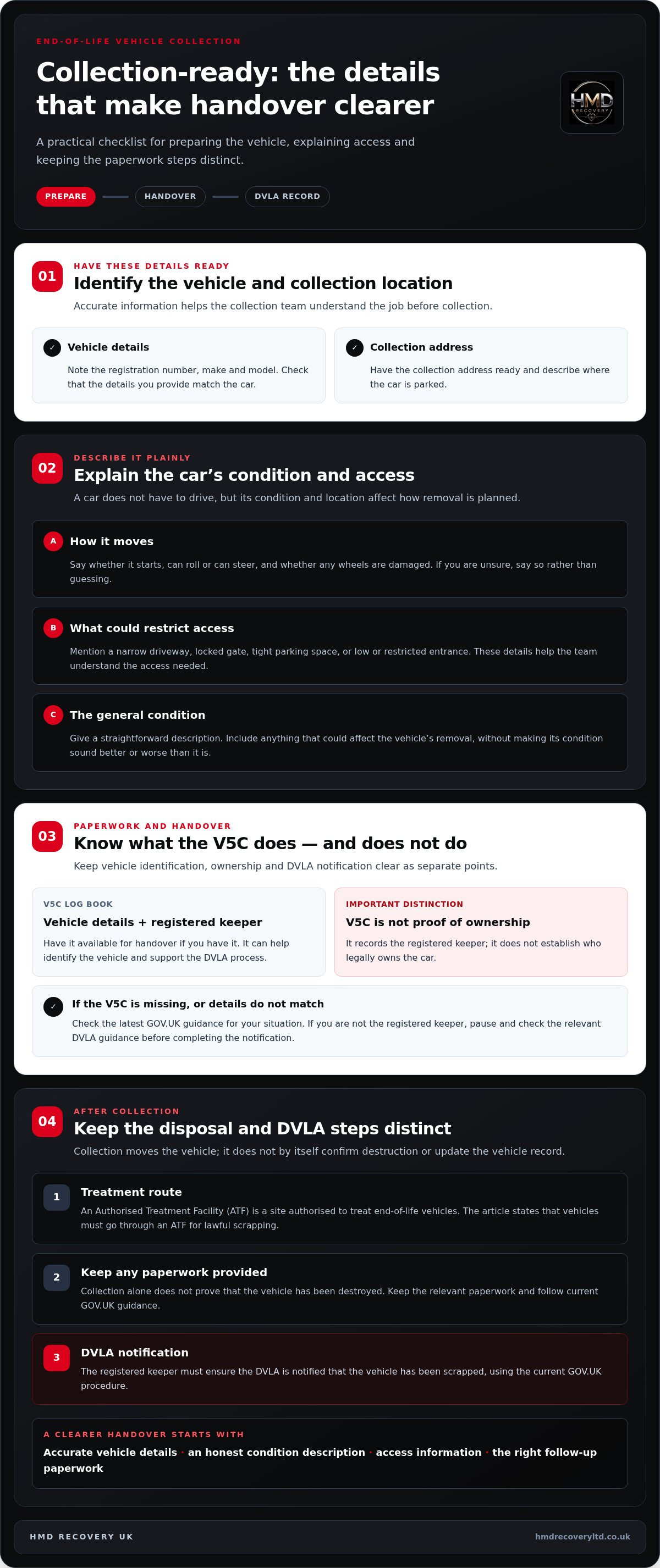
End of life car collection checklist: prepare the vehicle and access
A few checks before collection can prevent forgotten belongings and unclear access details. Work through this list at your own pace. Don’t try to start, drive or move a car if it may be unsafe.
- Confirm where the car is. Note the full collection address and whether it’s on a driveway, by the roadside, in a car park or elsewhere on the property.
- Describe its condition. Tell the collection team if it won’t start, has damage, can’t roll or steer, or has a damaged wheel. Share what you know, and don’t guess.
- Explain access. Mention narrow entrances, gates, low headroom, shared parking or any other restriction. If the car is difficult to reach, describe what blocks access.
- Gather the keys. Keep any available keys somewhere easy to find for handover. If you don’t have them, say so when arranging collection.
- Empty the vehicle. Check the cabin and storage areas carefully before the car is taken away.
- Make the location easy to identify. Give clear directions if the car is not visible from the road, and explain where a collection vehicle can safely stop.
What should you remove from the car?
Check the boot, glovebox, door pockets and other storage spaces. Remove personal belongings, paperwork, documents and anything you want to keep. Look under seats and around the spare-wheel area if it’s accessible without disturbing the vehicle. Take a final walk-round. Don’t remove parts or materials unless there’s a clear reason and you can do so safely.
Remember items that are easy to overlook, such as a phone charger, sunglasses, parking permits or paperwork in the centre console. Once the vehicle has been handed over, retrieving forgotten belongings may be difficult. Set aside anything you want to keep before collection rather than relying on a last-minute search.
How can you make the collection location clear?
Give the full address and simple directions to the exact parking spot. Say whether the car is on a driveway, roadside, shared parking area or private land. Flag access limits early, including locked gates, narrow lanes or restrictions on where a vehicle can stop. Don’t move an unsafe car to make access easier; explain the situation instead.
Essex collection locations vary. A car on a rural property may be some distance from the road, while a vehicle in a town may be behind a narrow entrance or in shared parking. A clear description helps the team understand the approach and any obstacles before setting out.
For an end of life car collection in Essex, prepare the vehicle condition, keys and access details before arranging handover. Arrange scrap car collection with HMD Recovery UK and share where the vehicle is and what may affect access.
Arrange end of life car collection in Essex with HMD Recovery UK
Ready to arrange collection? Give a clear account of the vehicle and its location. HMD Recovery UK collects unwanted, scrap and MOT-failed vehicles in Essex, including cars that have reached the end of their useful life. A straightforward description helps plan collection around the car’s condition and the available access. Share what you know, even if the vehicle isn’t roadworthy.
What information helps arrange collection?
Have the registration number, make and model ready. Describe whether the car starts or moves, and mention visible damage or any issue that could affect loading or access. Be specific if it cannot roll or steer. If you don’t know, say so rather than trying to diagnose the problem.
Then give the Essex collection address and explain where the car is parked. Mention narrow entrances, gates, shared parking, restricted stopping or a rural location set back from the road. These details help the team understand the practical arrangements before collection. If the vehicle is behind another car or a barrier, explain that too.
- Vehicle registration, make and model.
- Whether it starts or can move, plus any visible damage.
- Full collection address and the vehicle’s exact location there.
- Access restrictions or anything that may make reaching the car difficult.
What happens at handover?
Before the agreed collection, have the car and any relevant paperwork ready. Remove personal belongings and documents you want to keep, and gather the available keys. If the vehicle’s condition or access has changed since you arranged collection, explain the change so the handover reflects the situation on site.
Keep any documents you receive during handover. Collection and vehicle treatment are separate stages, so the car’s removal alone doesn’t complete every disposal or DVLA step. The registered keeper should follow current GOV.UK instructions for notifying the DVLA after a vehicle is scrapped. Keep records together so you can refer to them if needed.
If you’re still weighing up the next steps, the guide to disposing of an old car covers the wider process, including preparation and paperwork. It can help you see how arranging transport fits into disposal, without confusing collection with the later steps.
Have the vehicle details and Essex address ready? Arrange end-of-life car collection with HMD Recovery UK and share the car’s condition and any access limits.
Make the next step a simple one
Once you’ve decided the car won’t be going back into regular use, set aside a few minutes to prepare for collection. Start with the car’s current condition and where it’s parked, then gather the details and paperwork you’ll need for handover.
HMD Recovery UK provides scrap car collection in Essex for end-of-life, unwanted and MOT-failed vehicles. Share your vehicle details, its location and any access restrictions to begin arranging collection.
Arrange end-of-life car collection in Essex with HMD Recovery UK.
Frequently Asked Questions
Can an end-of-life car be collected if it does not start?
Yes, a car that won’t start can still be collected for end-of-life disposal. Tell the collection team whether it can roll or steer, and mention issues such as a jammed wheel or electronic handbrake if you know about them. Don’t try to push or drive an unsafe vehicle to make it easier to reach. In Essex, share any access problems when arranging collection so the situation is clear.
Do I need the V5C to arrange end of life car collection?
Not necessarily. If the V5C log book is missing, you can still make arrangements, but the registered keeper must follow the current DVLA instructions for scrapping a vehicle. The V5C identifies the vehicle and its registered keeper; it isn’t proof of ownership. Check GOV.UK guidance for the correct steps in your circumstances, and don’t use an old form or assume that another person’s log book settles ownership.
What happens to my car after end-of-life collection?
After collection, the vehicle should go through the appropriate disposal route. In the UK, an Authorised Treatment Facility (ATF) handles end-of-life vehicle treatment. If the vehicle is scrapped, the ATF issues a Certificate of Destruction. Collection alone doesn’t mean the car has already been destroyed. Keep any paperwork you receive and distinguish a collection record from a Certificate of Destruction.
Do I have to tell the DVLA when my car is scrapped?
Yes. The registered keeper must notify the DVLA when the vehicle is scrapped. GOV.UK explains how to do this online or by post, depending on your situation and documents. Don’t assume the collector has completed this step for you. Follow the current official instructions and keep a record of your notification with the vehicle’s handover paperwork, so you can refer to it if questions arise later.
Should I remove the number plates before car collection?
Usually, leave the number plates on the car for collection. If you want to keep a personalised registration, arrange its retention or transfer with the DVLA before the vehicle is scrapped, and follow the instructions you’re given about the plates. Removing them doesn’t notify the DVLA that the vehicle has been scrapped. Check the latest GOV.UK guidance before handover if you’re unsure what applies to your registration.
Can an MOT-failed car be collected at the end of its life?
Yes. HMD Recovery UK collects MOT-failed vehicles in Essex. A failed MOT doesn’t automatically mean the car has reached the end of its useful life; it may still be repairable. Consider the faults and what you want to do next. If you’ve decided to scrap it, describe the test failure and any known issues when arranging collection. Don’t drive a vehicle you believe is unsafe.
What should I remove from a car before it is collected?
Take out personal belongings, paperwork and anything you want to keep. Check places that are easy to miss, such as the boot, glovebox, door pockets, centre console and under the seats. Remember parking permits, charging cables and items stored with the spare wheel. Make one final check before handover. You don’t need to remove vehicle parts or components as part of a basic belongings check.


