
Getting rid of an old car is straightforward when you know the right order. The main decisions are what to do with the vehicle, how to handle the DVLA paperwork and how to move it if it won’t start. This guide to how to dispose of an old car sets out the steps, so you can choose a route and complete the handover properly.
Not sure whether to sell, donate or scrap it? Start with the car’s condition and what you want from the handover. If it’s at the end of its life, use an Authorised Treatment Facility and make sure you receive a Certificate of Destruction. You’ll also need to notify the DVLA when the car is scrapped.
Use this checklist to compare your options, prepare the car and paperwork, and plan removal if it can’t be driven. HMD Recovery UK collects unwanted, scrap and MOT-failed vehicles in Essex, including non-running cars that can’t reach a facility under their own power.
Key Takeaways
- Choose how to dispose of an old car by weighing its condition, whether it can be driven and how much effort you want to put into the handover.
- Compare private sale, trade-in, donation and scrapping to find a route that suits your vehicle and priorities.
- Prepare the paperwork and clear personal belongings before the car changes hands.
- If the car won’t run, plan collection rather than trying to drive it.
- Essex owners can arrange collection of unwanted, scrap and MOT-failed vehicles with HMD Recovery UK. Share the car’s condition, location and collection needs.
How to dispose of an old car: start with its condition and your goal
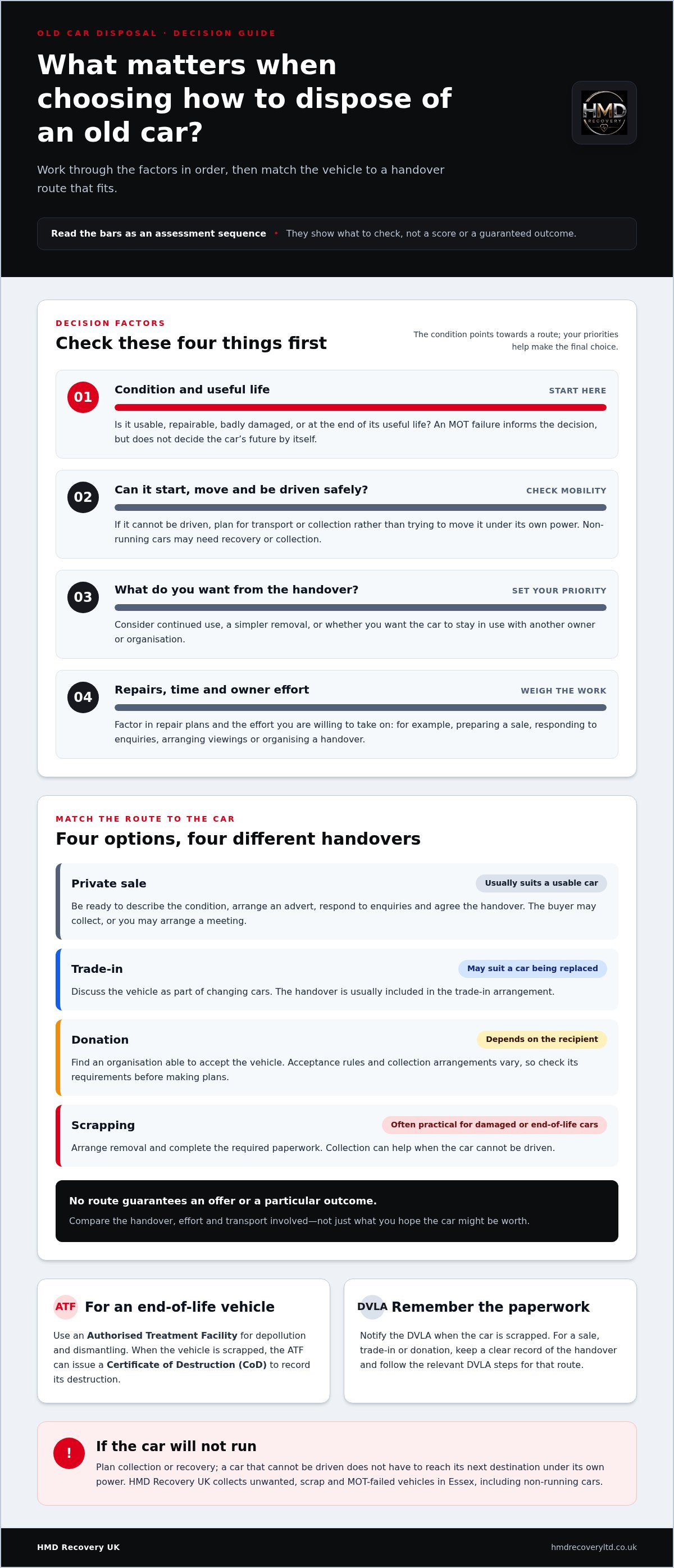
The right route depends on the car’s condition and what you want from the handover. If it runs and is safe to use, you could keep it, sell it or trade it in. If it’s damaged, has failed its MOT or has reached the end of its useful life, you may prefer repair, transport or scrapping. Start by establishing what the car can do, then weigh up the practical steps involved in each option.
Don’t use age or an MOT failure as the only deciding factor. Consider what repairs are needed, whether the car can be driven and whether you want to spend time getting it back on the road. An MOT failure can involve repairable issues, but it can also reveal faults that make continued use impractical. The test result informs your decision, but it doesn’t decide the car’s future for you.
Is the car still usable, repairable or at the end of its life?
Begin with a straightforward check. Does the car start and move? Is it safe and roadworthy? Could repairs make it suitable for continued use, or would you rather move on? If you’re unsure about the faults, a mechanic can explain the repair options. Weigh that advice against your budget, plans and the effort you want to put in.
A car that won’t start or can’t be driven doesn’t have to be driven to its next destination. It may need recovery or collection instead. This is a practical option for damaged, MOT-failed and unwanted vehicles, including cars at home that are no longer road-ready.
For a vehicle at the end of its life, responsible disposal means using a suitable treatment route rather than abandoning it or dismantling it unsafely. In the UK, an Authorised Treatment Facility (ATF) handles end-of-life vehicles for depollution and dismantling. The ATF can issue a Certificate of Destruction when the vehicle is scrapped. This document records its destruction.
What do you want from the disposal process?
Set your priorities before choosing a route. Is convenience most important? Would you prefer the car to stay in use? Are you prepared to arrange viewings, manage messages or organise repairs before handing it over? Your answers will help narrow down the options in the next section.
- Continued use: consider whether the car is suitable to keep or repair.
- Less owner effort: choose a route that avoids tasks you don’t want to take on, such as preparing the car for sale.
- Simple removal: if it can’t be driven, include transport or collection in your plan.
Don’t let the car’s potential value make the decision for you. Reusable parts may be one consideration, but so are your time, repair plans and collection needs. Decide what you want to achieve, then choose the route that fits.
The car’s condition points you towards a route; your priorities help you make the final choice.
The main ways to dispose of an old car in the UK
There isn’t one route that suits every vehicle. A car that’s safe to drive may still be useful to another owner, while a damaged or end-of-life vehicle may be better suited to scrapping. Compare the handover, effort and transport involved, not just what you hope the car might be worth. That makes it easier to decide how to dispose of an old car in a way that fits your circumstances.
| Route | Vehicle condition | Owner effort | Likely collection needs |
|---|---|---|---|
| Private sale | Usually most suitable for a usable car | Arrange the advert, respond to enquiries and organise handover | Buyer may collect, or you may arrange a meeting |
| Trade-in | May suit a usable car being replaced | Discuss the vehicle as part of changing cars | Usually handed over as part of the trade-in arrangement |
| Donation | Depends on the recipient and the car’s condition | Find an organisation that accepts it and arrange the handover | Collection arrangements depend on the recipient |
| Scrapping | Often practical for damaged, unwanted or end-of-life vehicles | Arrange removal and complete the required paperwork | Collection can help if the car can’t be driven |
When might selling, trading in or donating make sense?
A private sale can suit a car that remains usable if you’re willing to prepare it for handover. You’ll need to describe its condition clearly, handle enquiries and agree how the buyer will take possession. A trade-in may be more convenient if you’re replacing the car, as the handover forms part of that wider transaction. Donation is another option if an organisation is willing and able to accept the vehicle. None of these routes guarantees an offer or a particular outcome.
Acceptance rules and collection arrangements for donations vary, so confirm the organisation’s requirements before making plans. For a sale, trade-in or donation, keep a clear record of the handover and follow the relevant DVLA steps for that route.
When is scrap collection the practical route?
Scrapping may be sensible if the vehicle is no longer wanted, is badly damaged or has reached the end of its useful life. If it won’t start or can’t be driven, collection means you don’t have to move it under its own power. HMD Recovery UK collects unwanted, scrap and MOT-failed vehicles in Essex, including non-running cars.
For an end-of-life vehicle, use an Authorised Treatment Facility (ATF), an approved facility for handling and treating vehicles for scrapping. The ATF issues a Certificate of Destruction (CoD) to record that the vehicle has been destroyed. GOV.UK explains the requirements, including ATFs and DVLA notification, in its official UK government guidance on scrapping a vehicle.
If the car is in Essex and needs removing, scrap car collection in Essex can make the handover more practical. Next, compare the options against the car’s condition and the effort each route involves.
Compare your disposal options before deciding what to do
Compare the practical steps, not just the names of the options. A car that starts and can be driven gives you more handover choices. A seriously damaged car may need transport even if you haven’t decided to scrap it. Use the table to narrow down how to dispose of an old car based on its condition, whether it moves under its own power and how much time you can give the process.
| Vehicle condition | Can it be driven? | Owner effort | Handover to consider |
|---|---|---|---|
| Usable and wanted by someone else | Yes | Allow time to prepare the car, handle enquiries and agree the handover | Private sale, trade-in or donation |
| Repairable, but not currently road-ready | Not safely or reliably | Consider repair needs alongside arranging transport | Repair and keep, or arrange transport for another route |
| Damaged or no longer wanted | Maybe not | Share the vehicle’s condition and plan how it will be moved | Recovery or scrap collection, depending on your decision |
| At the end of its useful life | Often not | Arrange removal and the appropriate disposal handover | Scrap collection through the authorised treatment route |
Which route fits a usable or repairable car?
If the car is suitable for continued use, decide whether to keep it, sell it, trade it in or offer it for donation. Then consider the time involved. A private sale can mean preparing details and managing enquiries. A trade-in may fit naturally with replacing the vehicle. Donation depends on an organisation accepting the car. If it needs repairs, weigh the work involved against the effort of handing it over another way.
Which route fits a damaged or non-running car?
Separate the disposal decision from the transport problem. Recovery moves a vehicle that needs to go somewhere, for example for assessment or repair. Scrap collection is for a vehicle you’ve decided to dispose of through the appropriate route. If it’s at the end of its life, arrange disposal through an Authorised Treatment Facility.
An MOT failure doesn’t settle the choice by itself. Check what caused the failure and whether repairs are practical for you. The car may be repairable, or its condition and your plans may point towards scrapping. Base the decision on the actual faults, not just the failed test.
If the car can’t be driven, collection can remove the transport obstacle and let you focus on the handover. HMD Recovery UK provides vehicle recovery and scrap car collection in Essex, including for non-running vehicles. Compare the options with your circumstances, then use the checklist below to prepare.
Old car disposal checklist: paperwork, belongings and handover
A few checks before and after handover can help prevent missing paperwork or personal items. The steps vary depending on whether you’re selling, donating or scrapping, so follow the instructions for the route you choose. If you’re unsure how to dispose of an old car, use this checklist before it leaves.
What should you prepare before the car leaves?
Gather the vehicle’s available paperwork, especially the V5C logbook if you have it. The V5C is not proof of ownership, but its reference is needed for the online DVLA notification process when a car is scrapped. If the logbook is missing, the process is different. Follow the current GOV.UK instructions rather than relying on the online service.
Clear the car carefully. Check the glovebox, door pockets, boot and under the seats. Remove personal documents, house keys, parking permits and anything else you want to keep. If the car has a phone connection or infotainment system, remove paired devices and saved personal details where possible.
- Gather paperwork: locate the V5C and any records relevant to the handover.
- Clear the vehicle: check storage areas for belongings and personal documents.
- Make identification easy: have the registration number and location ready, and describe any damage or access issue clearly.
- Record the handover: keep any receipt or written confirmation, along with details of who took the vehicle and when.
These checks are particularly useful if the car is collected somewhere you can’t easily meet the driver. Keep your own copy of the handover record.
What should you complete after handover?
If the vehicle is scrapped, the registered keeper must notify the DVLA. The online GOV.UK service uses the 11-digit reference in the V5C and provides email confirmation. If you don’t have the V5C, follow the postal process instead. Keep the confirmation with your handover records. Handing over the keys does not complete the DVLA notification.
If an end-of-life vehicle is scrapped through an Authorised Treatment Facility, the facility issues a Certificate of Destruction (CoD) after the vehicle is destroyed. This is official proof of destruction, but it does not replace the relevant DVLA steps. The CoD is usually sent electronically to the last owner within seven days of destruction, according to current guidance.
Vehicle tax also needs attention. Once the DVLA records the car as scrapped, it automatically refunds any full months of remaining vehicle tax. The refund is sent by cheque to the registered keeper’s address, so make sure your address details are up to date.
For a non-running car in Essex, HMD Recovery UK can arrange scrap car collection. Arrange collection of your old car and share its condition, location and access needs.
Arrange old car collection in Essex with HMD Recovery UK
A car that won’t start or isn’t roadworthy can be difficult to move. HMD Recovery UK collects unwanted, scrap and MOT-failed vehicles in Essex, including cars that can’t be driven. Sharing a few practical details helps make the collection arrangements clear from the start.
Describe what the vehicle needs before arranging removal. A car that rolls and steers may be easier to move than one with locked wheels or damage that affects loading. You don’t need to diagnose a fault. Explain what you’ve noticed and where the car is parked.
What information helps arrange a scrap car collection?
Have the key details ready and be straightforward. Include:
- Location: give the address or site where the car is parked, along with useful access details.
- Condition: say whether it’s unwanted, scrap or MOT-failed, and mention visible damage or known problems.
- Movement: explain whether it starts, rolls, steers and can move under its own power.
- Access: note narrow entrances, restricted parking, gates or other obstacles that could affect reaching or loading the vehicle.
- Collection needs: share anything else that could help plan removal, such as where the car is positioned or whether keys are available.
Accurate details help avoid surprises at handover. If you’re unsure whether a fault matters, describe what happens rather than guessing at the mechanical problem. For example, “the engine won’t start, but the wheels turn” is more useful than guessing at the cause.
What happens next when you arrange collection?
Once you’ve shared the vehicle’s condition, location and access needs, the practical removal details can be discussed. Keep the conversation focused on anything that affects collection. If the car is tucked behind other vehicles or parked on private land, explain that early so the arrangements reflect the situation.
Before handover, remove belongings and personal documents from the vehicle. Gather the paperwork you have, including the V5C if available. Keep a record of what was agreed and who took the car. If you’re scrapping it, complete the relevant DVLA notification steps and retain the paperwork associated with the disposal route. Collection moves the vehicle; it doesn’t replace steps you need to complete as the registered keeper.
If the immediate issue is moving a car that can’t be driven, HMD Recovery UK also provides vehicle recovery and transport. A clear description of the location, condition and access helps explain what needs to happen next. This can make the job more manageable, whether the vehicle is awaiting assessment or being collected for scrap.
To arrange removal of an unwanted, scrap or MOT-failed vehicle in Essex, arrange scrap car collection with HMD Recovery UK.
Take the next step with confidence
Working out how to dispose of an old car is easier when you turn the decision into one clear next step. Choose the route that suits the vehicle and your priorities, then take action rather than letting the car become a task you keep putting off.
If collection is the right option, share the details that will help organise the handover: the car’s condition, location and access needs. A straightforward conversation can clarify what needs to happen next.
Arrange scrap car collection with HMD Recovery UK for an unwanted, scrap or MOT-failed vehicle in Essex.
Frequently Asked Questions
Can I dispose of an old car without the V5C log book?
Yes, but scrapping a car without the V5C log book involves a different process. You can’t use the DVLA’s online scrapping notification service without the document, so follow the current postal instructions on GOV.UK. The organisation handling the vehicle may also need other proof that you’re entitled to hand it over. If you’re disposing of an old car without its log book, gather any relevant records before arranging removal.
Do I need to tell the DVLA when I scrap or dispose of my car?
Yes. If you’re the registered keeper and the car is scrapped, you must notify the DVLA. Use the GOV.UK online service with the reference from your V5C, or follow the postal process if you don’t have the log book. If you sell or transfer the car instead, use the relevant DVLA process to record the change of keeper. Keep the confirmation with your records.
What happens if I scrap a car but do not receive a Certificate of Destruction?
Contact the Authorised Treatment Facility that handled the vehicle and ask about the Certificate of Destruction. An ATF should issue this proof after the car is destroyed; it’s usually sent electronically within seven days of destruction. Keep your collection or handover record and complete the separate DVLA notification. If the certificate still hasn’t arrived, use the ATF’s details and your vehicle registration to follow up.
Can I scrap a car that has failed its MOT?
Yes. An MOT failure doesn’t prevent you from scrapping the car. First decide whether you want to repair or dispose of it. Don’t assume a failed test means the vehicle is safe to drive; check the MOT result and any listed dangerous defects before moving it. If you choose to scrap it, arrange an appropriate handover. In Essex, HMD Recovery UK collects MOT-failed vehicles, including cars that need collection rather than driving.
Can an old car be collected if it does not start?
Yes. A car that won’t start can still be collected, so you don’t need to get it running just to arrange removal. Tell the collection team where it’s parked and whether it can roll or steer. Mention obstacles such as a narrow driveway, locked wheels or limited access. These details help explain what’s involved in moving the vehicle from its current location.
Do I need to cancel my car tax or insurance after disposal?
For a scrapped car, the DVLA cancels the vehicle tax after it records the disposal and automatically refunds any full remaining months of tax to the registered keeper. You don’t need to make a separate tax refund claim. Contact your insurer to end or amend the policy, and ask how it handles any remaining cover. Keep your DVLA confirmation and insurance correspondence with your handover records.
Can I dispose of a car that is not registered in my name?
Don’t notify the DVLA as though you’re the registered keeper. Contact the person named on the V5C and arrange for them to take part in the handover and complete the required DVLA steps. If they can’t be present, agree how they’ll authorise the arrangements and provide any documents needed. If a car has been left on your property, establish who is entitled to dispose of it before arranging collection.


